Riding the whelm
Reflecting on a morning event around the book 'Overwhelmed' after a week oscillating close to my own overwhelm due to a curve ball on Monday.

After I found out a project I was working on went on pause this week, I went into a bit of a spin.
I’d missed a Whatsapp message and a slack message from Friday with the news, and was set for 3 intensive days of big thinking work for the gnarly challenge we were working on. I’d just bought a coffee from around the corner of the office, clearing some other tasks before diving in deep. I checked my messages about 20 mins before going in, and my whole week and mood changed.
Last week, I could only do 1 day with that client because of two different team workshops last week I was preparing for and running. The week was super full, in lots of good ways. Interesting. Revenue generating. Relationally important.
I thought my week would be full again, and I’d be able to earn some more cash to help keep the lights on, the mortgage paid, and the family fed.
But shit (and shift) happens.
Suddenly my week looked way more open.
There were people I could meet.
Things I could do that have been on repeated to-do lists for the last few months, if not over a year.
There were things I could do for end of month.
Things for my long-term future.
Things that could help me get some more business in.
I was flooded with possibilities.
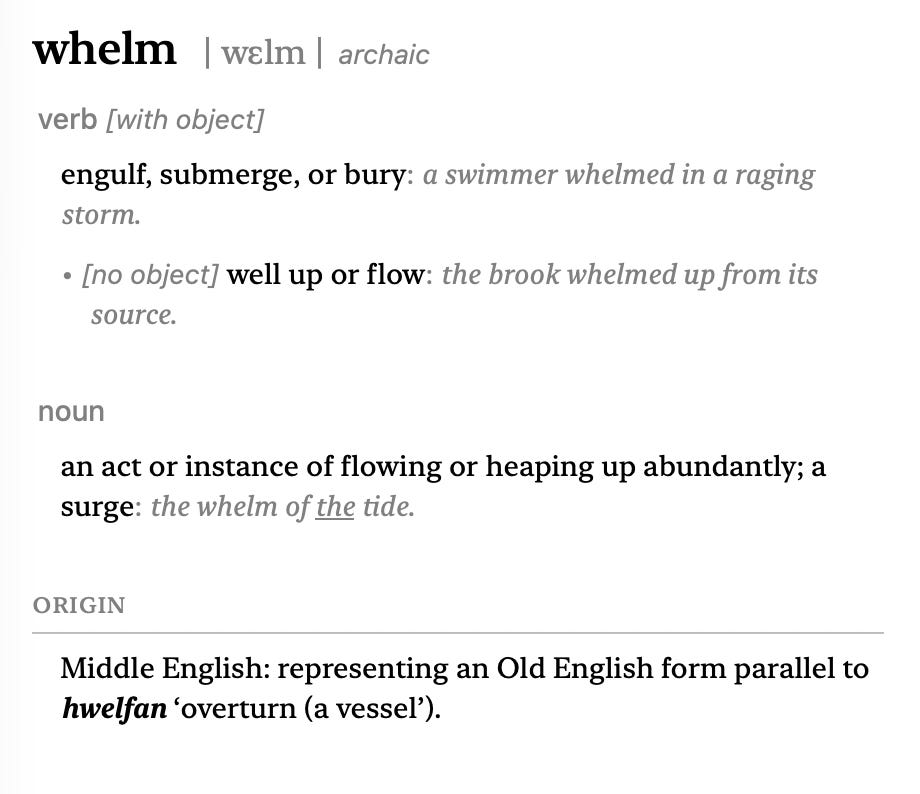
I could feel the whelm rising.
I hopped on a bike, and found a familiar spot to work for a few hours before the laptop curfew kicked in. I created lists. Visual ones. Digital ones. I even started trying a new ADHD-friendly tool that someone in a community I was in recommended. I checked in on some communities I found myself drifting away from.
I then managed to tick a few things off, but was feeling myself becoming overwhelmed by the situation as I ventured homewards. My mood thickened. The tributaries of catastrophic thought expanding. ‘Catastributaries’ even?
Or maybe that’s a bit of a portmanteau mouthful too far…
I decided to step into a Popeyes in Richmond and order some of the cheapest things I could get. I got a booth and got the laptop out again.
Suddenly, an idea re-emerged that connected a bunch of dots, and I got locked in despite the banging music in Popeyes. Usually it’s a bit more uplifting and tolerable. But even so it didn’t distract me too much. I was riding something I knew would be valuable at some point. I renewed my Mentimeter license so I could download 8 years of data from a question I’d been asking in various talks and workshops and start analysing it. I made a short post and re-motivated myself to do something more with it.
I left feeling like I had done something positive. I’d kept my head above the whelm, and not been consumed and paralysed by it.
My evening mood fluctuated but I could feel my worry and bad mood growing with an ever growing list of things I could do. Uncertain about what I could plan given next week’s uncertainty.
I decided I needed to go to bed and start afresh for a day where I’d crack through my list in a more prepared fashion.
On Tuesday, I managed to get on the case early. Tackle some boring admin tasks. Eat some huge frogs, manage some expectations of others for getting back to folk, and work out a plan ahead. I waded through and up the whelm, to rise up with my head able to see forwards towards the horizon.
On Wednesday, this morning in fact, I started writing this piece ahead of my weekly Write Club, after some juggling of my diary, I attended a Books for Breakfast event about the book ‘Overwhelmed’ with the author Claudia Hammond and the host Richard Kilgarriff. Through the session I was reminded of a few things that I know, but forget sometimes, and also learned a few other things that I’m sure will help me, my clients, and maybe you in the future. So I thought I’d share some of them with you below.
NB, these reflections are a mix of Claudia’s well researched perspectives based on academic studies, my own perspectives and some input from the audience.
As she reassuringly posed to the audience, don’t let anyone tell you that something will definitely work for you. No study had proven that for anything she’d looked into.
A backdrop of increasing overwhelm through perfectionism, social media, and over confidence in self
More people talking about mental health more
Claudia said she’d been working around mental health for 30 years and more people seemed comfortable talking about it. Whereas she used to have to ask people if they felt comfortable associating their names with their experiences, now it feels rude to. That’s more for depression and anxiety than psychosis though which still feels too stigmatised for many.
Perfectionism increasing
Claudia talked about perfectionism growing over time. Not a lot of depth on this, but one important note was that this had started before social media, which has its own self image-related concerns, mentioned below. Some of it possibly because of survivorship biases from famous sports people or business people.
Unacceptable appearance growing drastically through social media
22% in 1980s to 3/4 of teenage girls five or so years ago (not sure of exact time ranges of this, or study source) she said of women feeling their physical body or face appearance (not their clothes) was ‘unacceptable’. Now that is a horrible situation, but I am sure relatable to many. Definitely one to check sources for.
Performative authenticity
One audience member talked about the counter-trend to a lack of authenticity, being more performative authenticity. For example, looking really good without makeup. The audience nodded along as we reflected on why that could be just as bad, as the fake pouting shots flooding our socials.
Busy lives and never-ending to-do lists
There was a bit of a discussion on how many items in people’s to-do lists. I joked ‘for the next hour?’, ‘next week?’, or ‘just today’?. Claudia made the point about to-do lists never being done, and being ok with that.
Relatable challenges around us, but what can we actually do?
So, against this backdrop, what are some ways you can tackle overwhelm?
NB, Claudia emphasised that her perspectives were more about limiting the overwhelm from happening in the first place rather than dealing with chronic overwhelm while you’re in it, but I’ll try to add my perspectives.
Writing To-do lists the night before to cognitively offload
Back to the to-do lists, according to Claudia in one study it was found that doing your to-do lists the night before meant people could get to sleep 9–15 mins earlier than those that didn’t. The notion of cognitive offloading, by writing lists in the first place, externalisation of these thoughts helping people feel like they were dealt with. Off their metaphorical plate, or swirling around in their heads offering some relief.
Worry postponement
A lot of overwhelm occurs around worrying about past events and future events, Claudia explained. Those damned ‘catastributaries’ (sorry, I won’t let it go, will I?) again for those future concerns maybe? Or those things that you might have done wrong in the past and how it may have affected someone.
She mentioned the concept of delaying worrying to a particular time of the day when you can actually deal with the specific worries.
This was a concept I learned on an NHS mental health group course. Capture your worries in a worry diary. And set a ‘worry time’ to go through and perform some CBT or analysis on them. It kinda worked for me when I was able to keep the worry diary to hand.
I believe this works like the cognitive offloading of to-do lists. The externalisation in itself helps. Knowing that you will deal with it later, helps relieve some of the burden.
Post brain cancer memory loss helping reduce overwhelm
This wasn’t an academic study, but more of a perspective from an audience member who shared her story of having her overwhelm eradicated after suffering from brain cancer led to her losing a lot of memories. Claudia connected this with memories. And I wondered whether it is an argument for what my therapist is getting at with releasing some of my historic trauma, to release myself into the present and reduce saying yes to things.
I’d certainly love to explore this some more. With that audience member. With my therapist. And through further research.
Saying no to more things in the future, and not being so over confident in our abilities to plan
Claudia talked about part of the problems are lists getting so big is that we might say yes to more things than we can handle. She said that when asked about something in the future you might do, say a few weeks or months in the future, have a think about whether you could do it next week. Just in case you might leave it to the last minute, like so many of us might do otherwise.
She also mentioned alongside this the confidence bias and planning fallacy of people who over-estimate what they can do in a certain time. For example, from one study, students, being more accurate about when others would complete their PHD than they were of themselves. They would make a lot more allowances, and apply more realism, to others in relation to sickness, broken technology, distraction and other contextual factors that they didn’t imagine for themselves.
Awe walks
One of my favourite, and relatable tonics for overwhelm was the notion of going for ‘awe walks’. 15 minute walks where people appreciated nature and other surroundings, whether people, leafs, rivers etc.. Apparently in one study, the ‘Awe Walkers’ had higher levels of wellbeing, and increased prosocial feelings towards other people than those who just walked for that time. But also, because each was asked to take a selfie picture to prove they went on their walk, there was an interesting observation that ‘Awe walkers’ reduced the size of themselves in relation to their surroundings over time. Whereas the controlled walkers group, centred featured themselves more in the frames.
Overview effects, to get perspective and weaken the whelm
Related to the awe walking, was the familiar story of astronauts who would come back changed after seeing the earth while in space. The so called ‘overview effect’.
A build on this was Claudia’s sharing of the dilemma that astronauts faced around choosing which two books they might take up into the space, only to find that when up in space they had too many admin things to do, and when resting they just wanted to look at earth.
She built on this further by describing how the philosopher Massimo Pigliucci (I believe) who created his own zoom-out slideshow of slides of differing levels of zoom to help get perspective. Sounds like a good excuse to watch the Eames’ brilliant ‘Powers of Ten’ to me. Andy Polaine would be proud of me. Definitely check out his podcast of the same name.
But Richard also mentioned about using Google Earth to zoom into places where he used to live to see how the areas changed. Some form of nostalgia trip. Something I might try for something else I was thinking about.
It felt like these stories were related to the concept of getting perspective. Recognising that maybe your worries might not be that significant in the grand scheme of things. That planet will still keep spinning. For a little time yet, anyway.
There was much more I could probably go into, but if I sweat it too hard (literally and physically) I may never complete this post. And my Write Club is due to end any minute. And my black keys are actually burning my fingertips as I sit outside this Starbucks in the sun.
I’m on a nostalgia trip of my own right now, meeting a design leader peer in Windsor. Which has lots of history to get perspective on, including my own from living nearby when I was at University in Egham. The area would certainly feature in my Google Earth tour.
I’ll leave this post (subject to a few edits) with a question from that cancer survivors,
‘How does overwhelm serve us?
Claudia had many answers related to the positives of stress. Which I think was part of the picture. I think I have got a few thoughts related to serendipity, creativity, and a growth mindset, but it’s an interesting question to sit with.
What I know is that I had to ride the whelm this week. I noticed overwhelm coming for me, and I had ways to tackle it. List-making. Re-planning. Re-finding opportunities. Connecting dots. Pushing through, and giving myself some rest time. All that, and actually going to the event this morning and heading to Windsor, Popeyes, my members club and other spots to find my flow(s). And do some proper irrigation on the various energies, to-dos, thoughts and actions.