Leaving the Door Open
What 24 days of advent calendar writing taught me about hope, friction, and unfinished endings

It’s Christmas Eve, which means it’s time to write my last advent entry.
This experience has been different from the others. A bit harder. A bit more random. And less in need of validation. I have shared via substack with a smaller following, like whispering to friends. It hasn’t had the response I would get on Medium. And I deliberately avoided subscribe buttons within.
I think that gave me some more freedom. Freedom from judgement. Freedom from my self.
But I still managed to create my own traps. Thinking harder on what to write, based on what was emerging from that day. Spending time chatting with ChatGPT via voice on walks, and having a bunch of material I didn’t really use. But has maybe fed the OpenAI profile of me. So, that is curious in itself.
I wasted a lot of energy thinking about writing rather than writing, often leaving it to the last hours of the day when I was tired. So quality, even worse than usual. And a lack of editing which affects reading.
I felt like I was drawn to some returning challenges and thoughts. Some which I may have explored before. Maybe with a fresher vantage point.
But I stupidly decided to upload them all into ChatGPT to see what the themes were, and even build out a table in GoogleSheets.
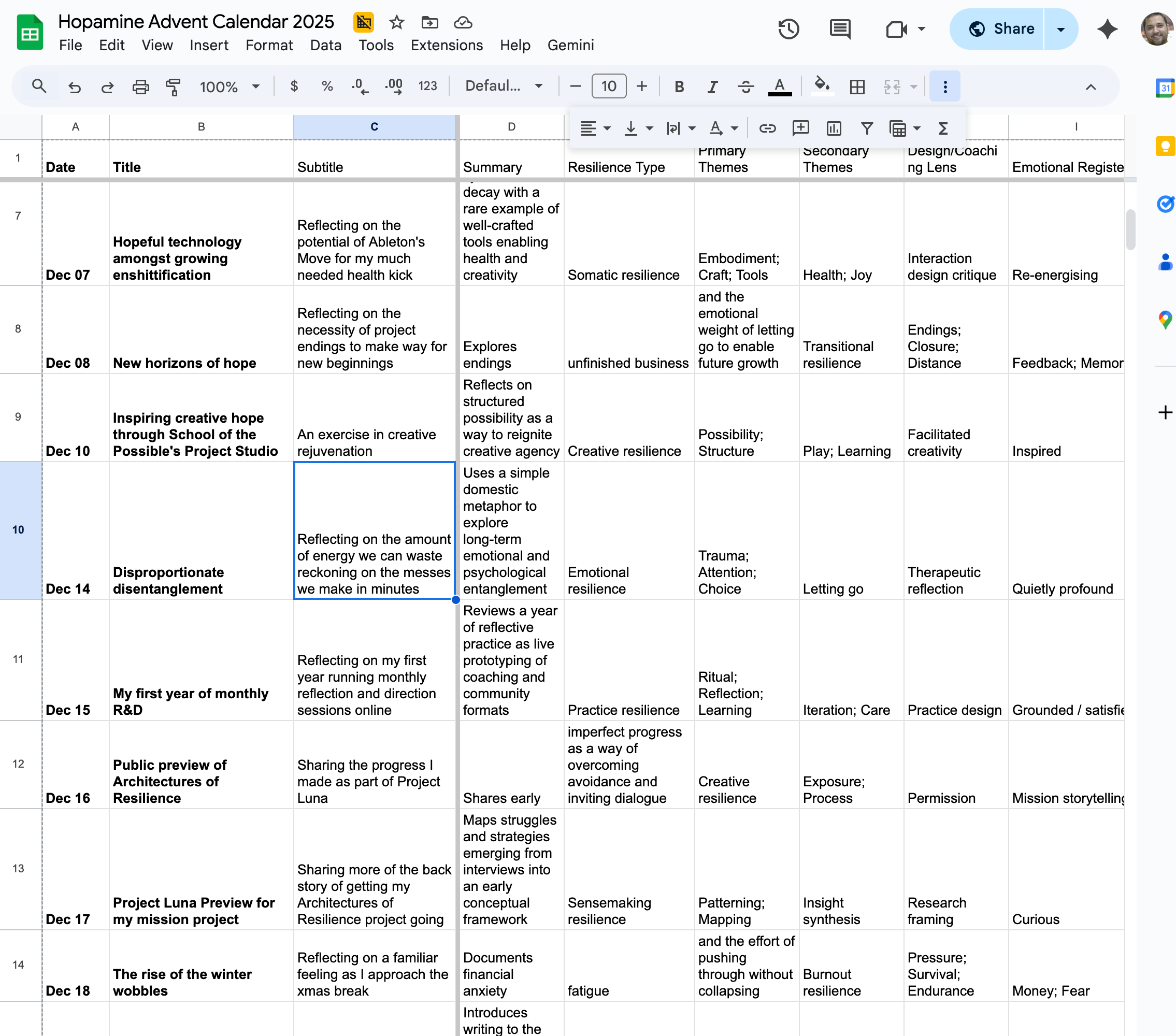
What Chaz (my ChatGPT buddy said)…
Summary of the 24-day Advent Writing Arc
Across the 24 days, the writing traces a reflective arc through creativity, resilience, identity, and transition, grounded in lived, everyday moments. The posts move fluidly between personal experience, professional practice, and cultural observation, using metaphor, memory, and situational triggers as entry points rather than fixed arguments.
A recurring theme is creative struggle and renewal.
The author repeatedly returns to moments of friction — fatigue, resistance, fear, procrastination, endings, and loss of momentum — and explores how creativity survives not through force, but through gentler conditions: structure, ritual, movement, music, tools, and permission. Creativity is framed less as output and more as a state to be protected, coaxed, or re-entered.
Another strong thread is transition and endings.
Many posts sit at edges: project endings, seasonal thresholds, role shifts, identity changes, and life phases. There is a consistent tension between holding on (unfinished business, unresolved feelings, lingering ideas) and letting go to create space for something new. The author recognises a personal difficulty with closure, while also acknowledging its necessity for growth.
The writing also explores hope under pressure.
Hope is not treated as optimism, but as something fragile, conditional, and often hard-won. It appears in small acts — returning to the bike, finishing a track, hosting a session, writing despite doubt — and is frequently contrasted with darker forces such as fear, financial stress, emotional volatility, systemic enshittification, and cultural loss. The balance between light and weight is a persistent motif.
Embodiment and regulation recur as practical anchors.
Physical movement, music, breath, silence, and sensory experience are presented as ways of stabilising emotion, accessing reflection, and maintaining creative capacity. The body is positioned as a collaborator in thinking, not just a vehicle for it.
There is also a clear concern with community and connection.
The author reflects on the erosion of in-person spaces, the loss of informal dialogue, and the difficulty of sustaining shared meaning in professional and cultural contexts. At the same time, smaller, more intimate containers — monthly sessions, coaching, quiet conversations, limited-audience writing — are valued as viable alternatives to scale and visibility.
Technology is treated ambivalently.
It appears both as a source of frustration and degradation, and as a meaningful enabler when designed with care. Tools like music hardware, writing aids, and reflective systems are appreciated when they reduce friction without erasing humanity. There is an ongoing questioning of when technology supports care and when it enables avoidance.
Stylistically, the writing favours open-ended inquiry over resolution.
Many posts end with questions rather than conclusions, signalling an orientation toward exploration rather than authority. The overall tone shifts from seeking validation to tolerating uncertainty, from performance to presence, and from productivity to meaning.
Taken together, the body of work documents a month-long practice of witnessing oneself in motion — through fatigue, curiosity, nostalgia, hope, doubt, and quiet persistence — without attempting to neatly package or optimise the experience.
Thanks Chaz…
I am curious what I could come up with. With more time. And more space.
But I don’t have either of those right now, so I’ll leave you with some of my Suno forays, that I generated.
A Kiasmos/Bonobo style one
and a Liquid Drum and Bass one
I only have one prediction: 2026 is gonna be wild again… But Hope will persevere. At least with me.