Defying darkness
Reflecting on carrying the weight without losing the light

It’s the Winter Solstice as I write this. The shortest day of the year. A day at an edge, or maybe more of a hinge. From here, the days lengthen. The sun slowly climbs higher in the sky. In the Northern Hemisphere at least.
Over the past few weeks I have been listening to the audiobook of Wintering by Katherine May. It is a rich account of the power and nourishment found in darker, colder times, whether seasonal or metaphorical.
Listening to it has brought me back to many conversations with my counsellor about my own darkness. Sometimes she wants to dig into it. To locate the sharp edges. The resolution and charge that sit inside trauma, frustration, anger, and dense emotional energy. She is kind and supportive, but at times it feels as though she becomes a journalist, intent on excavating a juicy story. Something revealing enough to cause a tremor in my voice, or a tear to surface.
Last year I remember sharing a genuinely positive week in a session. She did not seem as interested as I was. Instead, she steered me back toward something heavier that I did not want to talk about that day. Perhaps she thought I was avoiding something, or suppressing what mattered more.
‘Sometimes, I just want to celebrate the wins and the good’, I said.
‘That’s not what I’m here for’, she replied, or something similar.
What followed was a deeper discussion about human bias toward negativity and how that shows up in different professional practices.
Coaching, I explained, often carries a hope-fuelled bias. So does design at its best. A belief in possibility, imagination, and forward movement.
But some design practices, particularly UX, UCD, and related fields, lean heavily on critique. Risk identification. Externalities. Ethical failure modes. Dark or deceptive patterns. These disciplines often celebrate imagination and divergence far less than other design fields. I know many people in my career, myself included, who can bring a great deal of negative energy into the work. Not out of malice, but caution.
Counselling, at least as I have experienced it, often leans toward excavation. Digging into the past to understand how earlier pain shapes the present.
I believe there has to be balance, clichéd though that may sound.
Personally, I am at my best when I have both counselling and coaching in my life. Space to explore the heavy material, and space to build momentum. Or when challenging work is paired with room for creativity.
Too much critical thinking and negativity and we can wallow, or become paralysed.
Too much positivity and we risk insincerity, denial, or something close to toxic optimism.
For someone like me, with a lot of emotional volatility, there can be rapid movement between extremes. I have learned I need to limit how far I travel in either direction.
Walking through Hyde Park earlier today, my thoughts drifted to early rave culture. Mid-90s dancefloors oscillated between the moody darkness of darkcore and the extreme serotonin rush of happy hardcore. In a very short period of time there was a surge of emotionally charged innovation.
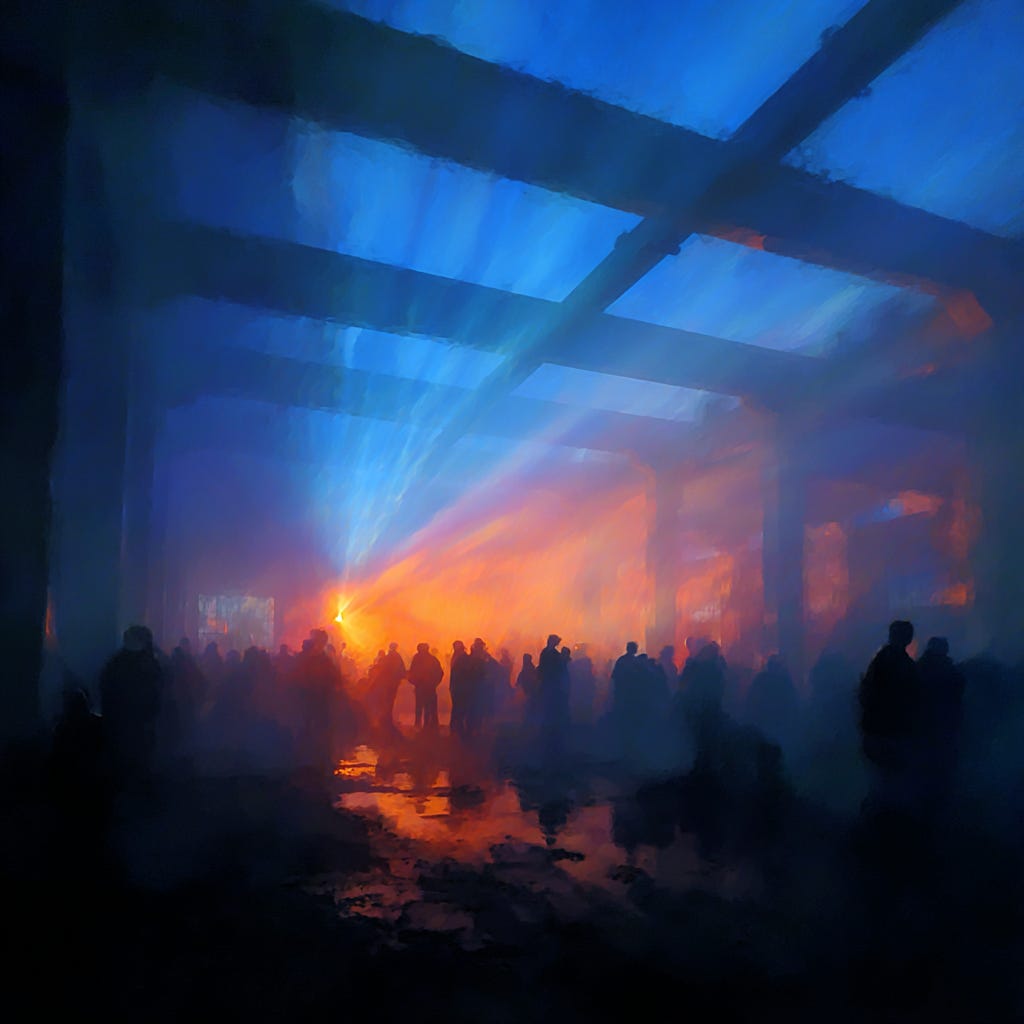
Different drugs aligned with different sounds. MDMA resonated with uplifting house and piano-led hardcore, full of sweaty euphoria and open-hearted connection. Gabba techno paired well with speed. Darkcore seemed closer to the dissociative edge of ketamine that sometimes crept into pills. Jungle’s aggressive textures matched the harsher energy of cocaine. Atmospheric and jazzy drum and bass sat comfortably alongside spliffs and the rise of trip hop.
When UK garage later exploded, indulgence and extravagance followed. Champagne, spirits, coke. Glossy, rude, exuberant.
I may be caricaturing these scenes and misrepresenting them slightly. I didn’t inhabit them equally. But as many of these sounds resurface now, I wonder how they map onto our current emotional landscape.
I also wonder about the non-chemical ways we amplify, complement, or soothe our inner states.
Music is one of them. As Max says in Stranger Things,
‘music has a way of finding you even in the darkest of places.’
Drum and bass producer Goldie often speaks about the tension between dark and light in the genre. Darkness as grief, rage, inner turmoil, and the realities of violence and struggle in urban environments.
That darkness is often where the weight lives. I sometimes think of these as weighty anchors in our lives that drag us down. Or ‘wanchors’ for short.
But without darkness, light has nothing to push against. Nothing to make it real. The hope after struggle. Learning earned through effort. Only fully understood in retrospect.
The light matters because of the weight. And the weight is survivable because of the light.
So is it right to defy the darkness, or endure it?
Seeking the texture and the richness from it, while also being open for the light that always returns.
I for one, am definitely looking forward to a little more light, and some longer days again. But I’m glad my random writing this December is out there in the world for me to come back to with a little more perspective.
Love these reflections Jason. I really enjoyed Wintering
"Wanchors". Congrats, Jason, that's a great new word in my vocabulary. Thanks for sharing. I found it interesting that your counsellor didn't seem that interested in celebrating the good things. I think it's as important, if not more, than always looking for unresolved issues. Balance is key :)